# HiFi-GAN
Training and inference scripts for the vocoder models in [A Comparison of Discrete and Soft Speech Units for Improved Voice Conversion](https://ieeexplore.ieee.org/abstract/document/9746484). For more details see [soft-vc](https://github.com/bshall/soft-vc). Audio samples can be found [here](https://bshall.github.io/soft-vc/). Colab demo can be found [here](https://colab.research.google.com/github/bshall/soft-vc/blob/main/soft-vc-demo.ipynb).
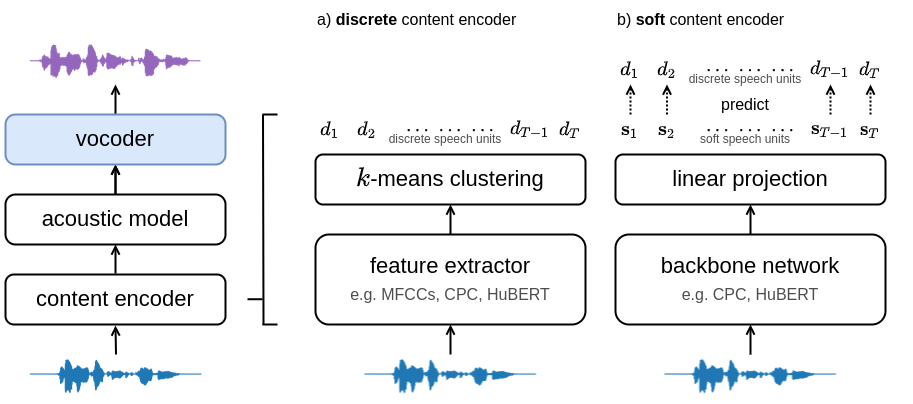
Fig 1: Architecture of the voice conversion system. a) The discrete content encoder clusters audio features to produce a sequence of discrete speech units. b) The soft content encoder is trained to predict the discrete units. The acoustic model transforms the discrete/soft speech units into a target spectrogram. The vocoder converts the spectrogram into an audio waveform.
## Example Usage
### Programmatic Usage
```python
import torch
import numpy as np
# Load checkpoint
hifigan = torch.hub.load("bshall/hifigan:main", "hifigan_hubert_soft").cuda()
# Load mel-spectrogram
mel = torch.from_numpy(np.load("path/to/mel")).unsqueeze(0).cuda()
# Generate
wav, sr = hifigan.generate(mel)
```
### Script-Based Usage
```
usage: generate.py [-h] {soft,discrete,base} in-dir out-dir
Generate audio for a directory of mel-spectrogams using HiFi-GAN.
positional arguments:
{soft,discrete,base} available models (HuBERT-Soft, HuBERT-Discrete, or
Base).
in-dir path to input directory containing the mel-
spectrograms.
out-dir path to output directory.
optional arguments:
-h, --help show this help message and exit
```
## Training
### Step 1: Dataset Preparation
Download and extract the [LJSpeech](https://keithito.com/LJ-Speech-Dataset/) dataset. The training script expects the following tree structure for the dataset directory:
```
└───wavs
├───dev
│ ├───LJ001-0001.wav
│ ├───...
│ └───LJ050-0278.wav
└───train
├───LJ002-0332.wav
├───...
└───LJ047-0007.wav
```
The `train` and `dev` directories should contain the training and validation splits respectively. The splits used for the paper can be found [here](https://github.com/bshall/hifigan/releases/tag/v0.1).
### Step 2: Resample the Audio
Resample the audio to 16kHz using the `resample.py` script:
```
usage: resample.py [-h] [--sample-rate SAMPLE_RATE] in-dir out-dir
Resample an audio dataset.
positional arguments:
in-dir path to the dataset directory.
out-dir path to the output directory.
optional arguments:
-h, --help show this help message and exit
--sample-rate SAMPLE_RATE
target sample rate (default 16kHz)
```
for example:
```
python reample.py path/to/LJSpeech-1.1/ path/to/LJSpeech-Resampled/
```
### Step 3: Train HifiGAN
```
usage: train.py [-h] [--resume RESUME] [--finetune] dataset-dir checkpoint-dir
Train or finetune HiFi-GAN.
positional arguments:
dataset-dir path to the preprocessed data directory
checkpoint-dir path to the checkpoint directory
optional arguments:
-h, --help show this help message and exit
--resume RESUME path to the checkpoint to resume from
--finetune whether to finetune (note that a resume path must be given)
```
## Links
- [Soft-VC repo](https://github.com/bshall/soft-vc)
- [Soft-VC paper](https://ieeexplore.ieee.org/abstract/document/9746484)
- [HuBERT content encoders](https://github.com/bshall/hubert)
- [Acoustic models](https://github.com/bshall/acoustic-model)
## Citation
If you found this work helpful please consider citing our paper:
```
@inproceedings{
soft-vc-2022,
author={van Niekerk, Benjamin and Carbonneau, Marc-André and Zaïdi, Julian and Baas, Matthew and Seuté, Hugo and Kamper, Herman},
booktitle={ICASSP},
title={A Comparison of Discrete and Soft Speech Units for Improved Voice Conversion},
year={2022}
}
```
## Acknowledgements
This repo is based heavily on [https://github.com/jik876/hifi-gan](https://github.com/jik876/hifi-gan).