mirror of
https://github.com/storytold/LiveScan3D.git
synced 2026-10-09 00:09:58 +00:00
 Marek
Marek
43 lines
3.3 KiB
Markdown
43 lines
3.3 KiB
Markdown
# LiveScan3D #
|
||
LiveScan3D is a system designed for real time 3D reconstruction using multiple Kinect v2 depth sensors simultaneously at real time speed.
|
||
|
||
The produced 3D reconstruction is in the form of a coloured point cloud, with points from all of the Kinects placed in the same coordinate system. Possible use scenarios of the system include:
|
||
* capturing an object’s 3D structure from multiple viewpoints simultaneously,
|
||
* capturing a “panoramic” 3D structure of a scene (extending the field of view of one sensor by using many),
|
||
* streaming the reconstructed point cloud to a remote location,
|
||
* increasing the density of a point cloud captured by a single sensor, by having multiple sensors capture the same scene.
|
||
|
||
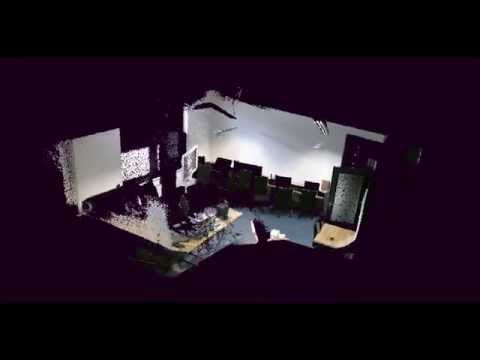
You will also find a short presentation of LiveScan3D in the video below (click to go to YouTube):
|
||
[](http://www.youtube.com/watch?v=9y_WglwpJtE)
|
||
|
||
At the moment connecting multiple Kinect v2 devices to a single computer is difficult and only possible under Linux. Also, the number of the devices or capture speed might be low, because of the limitations of the PCI-E bus.
|
||
|
||
Because of those limitations, in our system each Kinect v2 sensor is connected to a separate computer. Each of those computers is connected to a server which governs all of the sensors. The server allows the user to perform calibration, filtering, synchronized frame capture, and to visualize the acquired point cloud live.
|
||
|
||
## How to use it ##
|
||
To start working with our software you will need a Windows machine with the Kinect for Windows SDK 2.0, and at least a single Kinect v2 device. You can either build LiveScan3D from source which is easiest using Visual Studio, or you can download the binary release.
|
||
|
||
Both the binary and source distributions contain a manual (in the docs directory) which contains the steps necessary to start working with our software (it won't take more than a couple of minutes to set up).
|
||
|
||
## Where to get help ##
|
||
If you have any problems feel free to contact us: Marek Kowalski <m.kowalski@ire.pw.edu.pl>, Jacek Naruniec <j.naruniec@ire.pw.edu.pl>. We usually answer emails quickly (our timezone is CET).
|
||
|
||
For details regarding the methods used in LiveScan3D you can take a look at our article: "LiveScan3D: A Fast and Inexpensive 3D Data Acquisition System for Multiple Kinect v2 Sensors" once it is released.
|
||
|
||
## Licensing ##
|
||
While all of our code is licensed under the MIT license, the 3rd party libraries have different licenses:
|
||
* nanoflann - https://github.com/jlblancoc/nanoflann, BSD license
|
||
* OpenCV - https://github.com/Itseez/opencv, 3-clause BSD license
|
||
* OpenTK - https://github.com/opentk/opentk, MIT/X11 license
|
||
* ZSTD - https://github.com/facebook/zstd, BSD license
|
||
* SocketCS - http://www.adp-gmbh.ch/win/misc/sockets.html
|
||
|
||
If you use this software in your research, then please use the following citation:
|
||
|
||
Kowalski, M.; Naruniec, J.; Daniluk, M.: "LiveScan3D: A Fast and Inexpensive 3D Data
|
||
Acquisition System for Multiple Kinect v2 Sensors". in 3D Vision (3DV), 2015 International Conference on, Lyon, France, 2015
|
||
|
||
## Authors ##
|
||
* Marek Kowalski <m.kowalski@ire.pw.edu.pl>, homepage: http://home.elka.pw.edu.pl/~mkowals6/
|
||
* Jacek Naruniec <j.naruniec@ire.pw.edu.pl>, homepage: http://home.elka.pw.edu.pl/~jnarunie/
|